
Kathmandu, Nepal | August 2, 2026
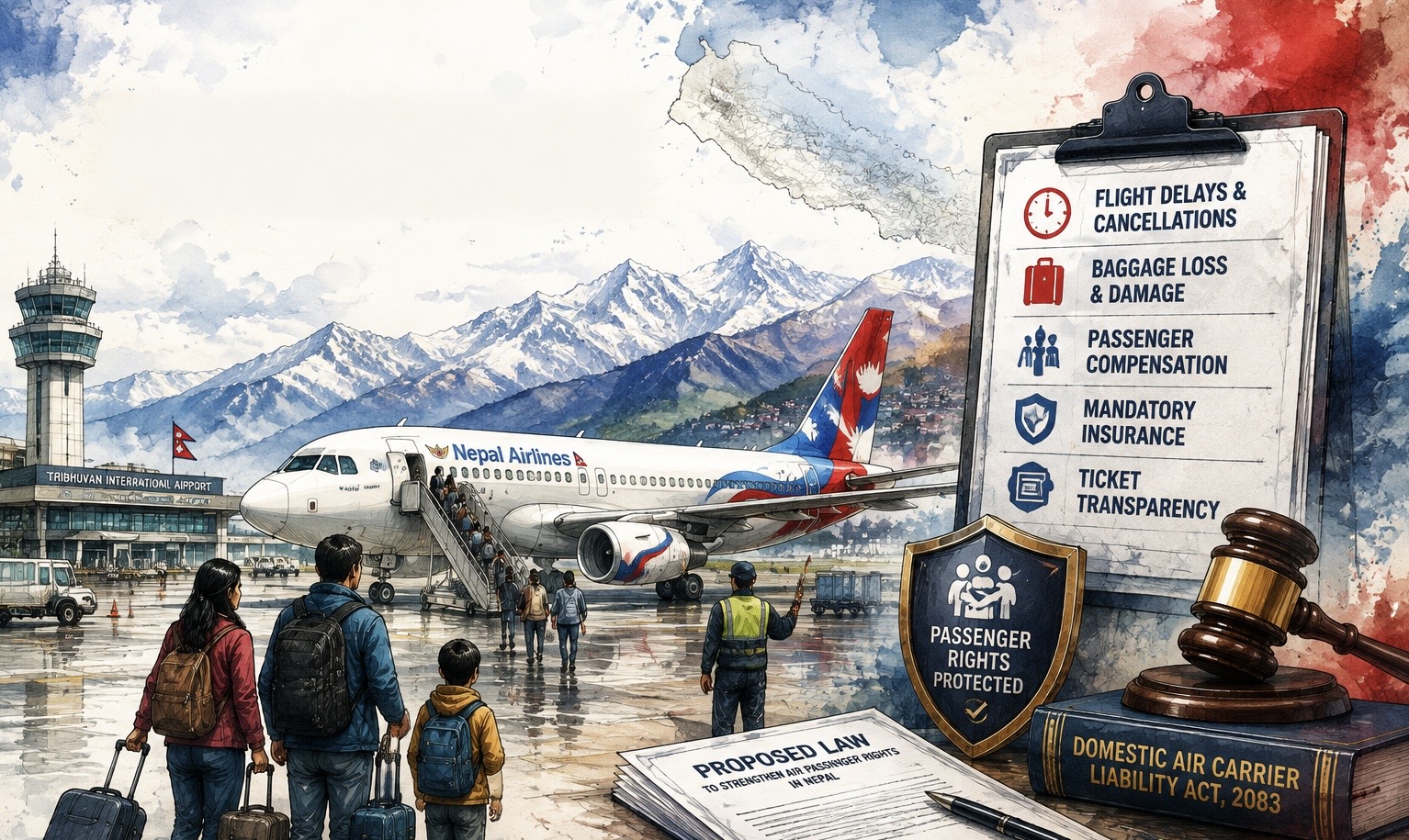
The Government of Nepal has proposed a new law aimed at making domestic air travel safer, more reliable, and more passenger-friendly by clearly defining the legal and financial responsibilities of domestic airlines.
The proposed Domestic Air Carrier Liability Act, 2083 (2026), registered in the Federal Parliament by the Ministry of Culture, Tourism and Civil Aviation, introduces comprehensive provisions covering flight delays, cancellations, passenger compensation, baggage loss, cargo damage, insurance requirements, and airline liability in accidents.
Under the proposed legislation, airlines will be legally obligated to transport ticketed passengers safely to their destinations on the scheduled date and time. If a flight is disrupted due to the airline’s negligence, passengers will be entitled to claim compensation.
Mandatory Notification for Flight Disruptions
Airlines will be required to notify passengers at least three hours in advance if a flight is delayed, cancelled, or postponed. Where disruptions occur due to reasons attributable to the airline—or when passengers holding valid tickets are denied boarding because of aircraft weight limitations—the airline must provide compensation and passenger assistance as prescribed by law.
Greater Ticketing Transparency
The bill also mandates greater transparency in airfare pricing. Airlines must clearly itemize the ticket fare, airport service charges, and government taxes. Failure to disclose these charges separately would constitute an offense under the proposed law.
Compensation Increased to US$100,000
One of the most significant reforms is the increase in compensation for fatalities resulting from domestic aviation accidents.
The proposal raises the maximum compensation for the death of a passenger or third party to the equivalent of US$100,000 in Nepali currency. In addition, airlines must immediately provide at least NPR 500,000 to the deceased’s next of kin to cover funeral expenses. This amount will later be adjusted against the final compensation settlement.
The proposal replaces the decades-old compensation framework based on the 1929 Warsaw Convention and the 1955 Hague Protocol, under which the maximum compensation was limited to US$20,000.
Injury, Baggage and Cargo Liability
Airlines will also be responsible for covering the full medical expenses of passengers or third parties injured in aviation accidents. Compensation of up to US$100,000 may be awarded for permanent disability or serious bodily injury.
For checked baggage, airlines would be liable to pay US$20 per kilogram, up to a maximum of US$500, if baggage is lost, destroyed, or damaged. Airlines may also be held responsible for damage to passengers’ hand-carried baggage caused by airline negligence.
The proposed law further strengthens protections for cargo owners. If declared-value cargo is lost or damaged, compensation must equal the declared value. Where no value has been declared, compensation would be US$10 per kilogram. Cargo delayed beyond the prescribed delivery period would also qualify for compensation, while cargo not delivered within 15 days would be deemed lost.
Mandatory Insurance Requirements
Every domestic airline would be required to maintain comprehensive insurance covering passengers, cargo, third-party liability, war risks, terrorism, and rescue operations.
If an airline fails to obtain the mandatory insurance, the aviation regulator may issue a directive requiring compliance within 35 days. Failure to comply could result in suspension of flight operations and cancellation of the airline’s Air Operator Certificate (AOC).
Compensation Claims and Appeals
The bill establishes clear deadlines for compensation claims. Claims involving death or permanent disability must be filed within 90 days, while claims related to flight disruptions, baggage, or cargo must be submitted within 30 days, supported by relevant evidence.
Airlines must issue a decision within 60 days of receiving a claim. If the claimant is dissatisfied, an appeal may be lodged with the Director General of the Civil Aviation Authority within 30 days.
Stronger Penalties for Non-Compliance
The proposed legislation introduces stricter financial penalties for airlines violating passenger protection provisions.
Airlines may face fines ranging from NPR 10,000 to NPR 50,000 for failing to disclose ticket charges, provide timely flight information, or pay required compensation.
Failure to maintain mandatory insurance or refusal to pay compensation in serious cases could attract fines ranging from NPR 1 million to NPR 2.5 million. Repeat violations would result in doubled penalties.
The government has also proposed reviewing compensation limits every 10 years, taking national inflation into account to ensure compensation remains relevant.
Exceptions
The proposed law exempts airlines from compensation obligations when flight delays or cancellations are caused by circumstances beyond their control, including adverse weather, natural disasters, or air traffic management restrictions.
If enacted, the legislation would represent Nepal’s most comprehensive reform of domestic airline passenger rights and carrier liability, aligning the country’s aviation framework with modern passenger protection standards.




Facebook Comments