
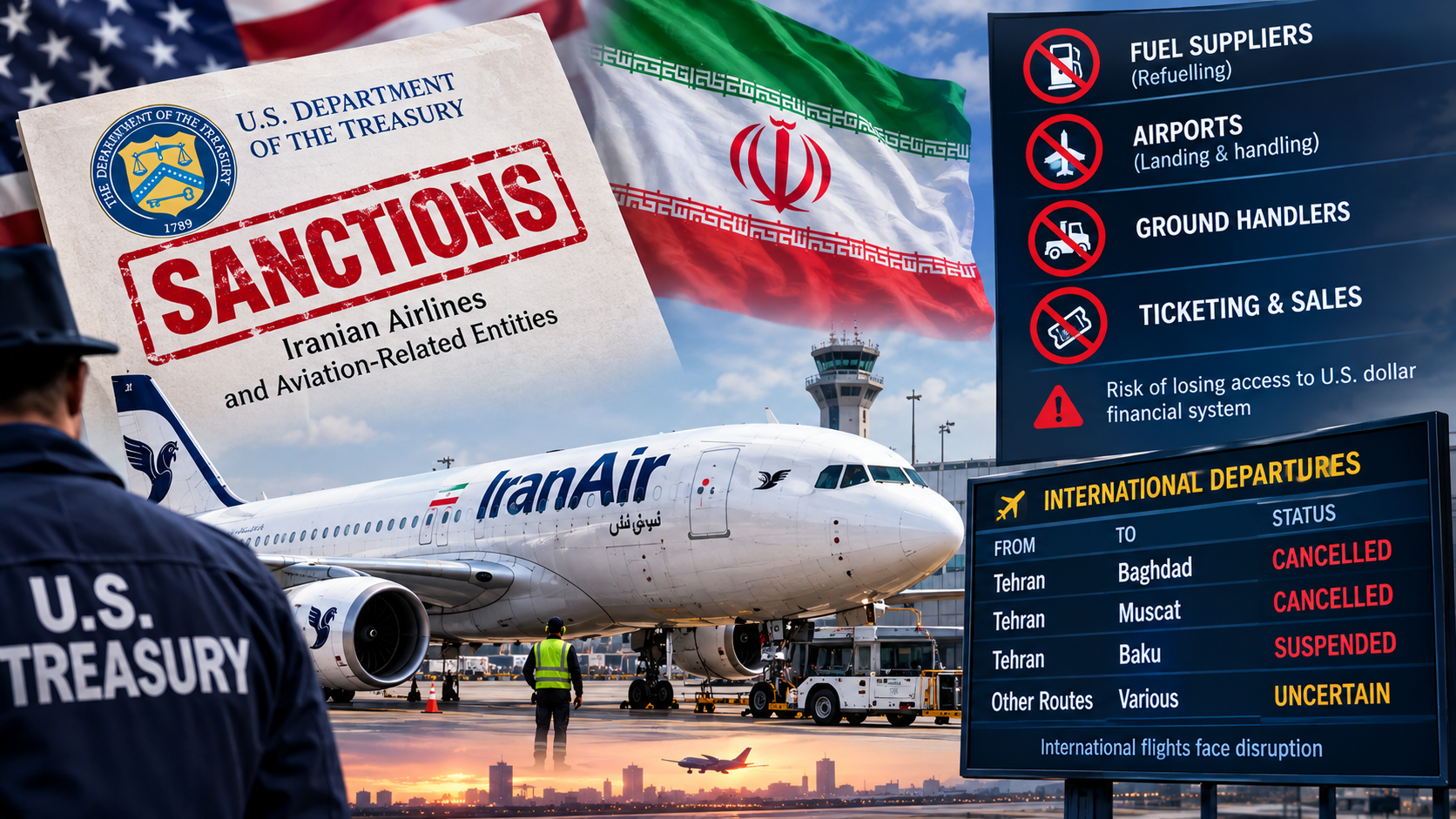
WASHINGTON, Sept. 23, 2026 — Iranian airlines are facing growing disruption to their international operations as the United States moves to impose secondary sanctions on foreign companies providing essential aviation services to Iranian carriers.
The U.S. Treasury Department announced on September 8 that it had sanctioned all remaining Iranian airlines as part of its broader sanctions campaign against Tehran. The measures also target companies and intermediaries supporting Iran’s aviation sector.
The latest warning goes beyond Iranian airlines themselves. U.S. Treasury Secretary Scott Bessent said foreign airports, fuel suppliers, ground-handling companies and ticketing businesses could face consequences if they continue providing services to Iranian carriers after September 23.
Bessent said companies servicing Iranian aircraft could risk losing access to the U.S. dollar-based financial system. The threatened measures cover services including aircraft refuelling, landing assistance and ticket sales.
International Flights Already Affected
The sanctions pressure has already begun affecting Iranian international services.
Iranian authorities announced that flights between Tehran and Baghdad and Tehran and Muscat would be suspended from September 23 after the respective airports moved to restrict Iranian flights. Iranian officials have been discussing the possibility of diverting Baghdad-bound services to Najaf instead.
Azerbaijan has also suspended flights operated by Iranian airlines, while other international routes face uncertainty as airports and aviation-service providers assess the potential consequences of continuing to serve Iranian carriers.
Despite the restrictions, Iranian airlines were still operating some international flights on September 23, with reported departures to destinations including Bangkok, Phuket, Shanghai and Kabul. This indicates that the U.S. measures have not immediately grounded every Iranian aircraft worldwide.
Pressure on the Global Aviation Supply Chain
The U.S. strategy focuses on the services Iranian airlines need to operate outside Iran. Without access to fuel, airport handling, landing services and ticket distribution, maintaining international routes becomes significantly more difficult.
The measures could therefore affect not only airlines but also airports, fuel companies, ground handlers, cargo providers and sales agents that maintain commercial relationships with Iranian carriers.
The U.S. Treasury said its September 8 action sanctioned 27 Iranian airlines and nine additional aviation-related targets, describing the aviation sector as part of Iran's infrastructure for transporting personnel, weapons and other cargo.
Uncertainty for Passengers
The developments are creating uncertainty for passengers travelling between Iran and neighboring countries. Routes could be suspended, redirected or operated through alternative airports depending on whether local aviation companies continue providing services to Iranian airlines.
Iranian carriers have a relatively limited international network compared with major global airlines, but the restrictions could further reduce direct air links and increase reliance on foreign carriers and indirect connections.
For international airports, meanwhile, the sanctions create a difficult commercial and regulatory environment: continuing to service Iranian aircraft could expose companies to U.S. financial restrictions, while refusing service could disrupt existing passenger and cargo operations.
The situation is expected to remain fluid as airports, airlines and aviation service providers determine how to respond to the U.S. sanctions and their potential financial consequences.




Facebook Comments