
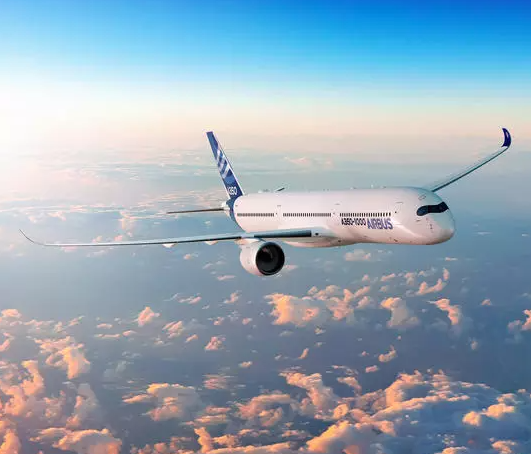
Toulouse, France | 10 November 2026-Airbus has announced a major milestone in commercial aviation, with its A350-1000ULR (Ultra-Long Range), developed for Qantas Airways under Project Sunrise, officially setting a new Guinness World Record for the longest flight by distance completed by a commercial airliner.
According to Airbus, the record-breaking flight covered an impressive 12,503 nautical miles (23,155 kilometres), with a total flight duration of 24 hours and 24 minutes. The aircraft departed Melbourne, Australia, on 27 July 2026, at 5:27 p.m. local time and arrived in Toulouse, France, at 9:51 a.m. local time on 28 July 2026.
The achievement was independently validated using aircraft flight data by the International Aeronautical Federation (FAI) and Flightradar24, confirming the record-setting performance.
A Landmark Flight for Ultra-Long-Haul Aviation
The flight was conducted as part of Airbus' flight-test campaign for the A350-1000ULR, which is being developed specifically to support Qantas' ambitious Project Sunrise programme.
The test mission was designed to demonstrate the aircraft's capability to undertake extremely long-distance commercial operations, including a requirement to simulate a 23-hour block time, measured from aircraft pushback at departure to arrival at the parking position.
During the journey, the aircraft followed a route from Melbourne over Sydney and across the Pacific Ocean towards Los Angeles. It subsequently crossed North America and the Atlantic Ocean before flying over the United Kingdom and continuing to Toulouse, France.
The remarkable journey crossed three continents and two oceans, with the crew experiencing two sunsets and two sunrises during the flight.
A total of 13 people were onboard, including three Airbus flight-test pilots, two Qantas pilots, five Airbus flight-test engineers, two Airbus design engineers and one representative from the International Aeronautical Federation.
Advanced Engineering to Enable Non-Stop Global Connectivity
The A350-1000ULR incorporates specialised modifications to extend the aircraft's operational range while maintaining efficiency and commercial viability.
One of its key modifications is the integration of an additional Rear Centre Tank (RCT) into the aircraft structure. This additional fuel capacity increases the aircraft's range by approximately 1,000 nautical miles compared with the standard A350-1000.
These enhancements will enable Qantas to introduce non-stop services between Sydney and London, as well as Sydney and New York, with flight durations of up to 22 hours.
Commenting on the achievement, Lars Wagner, Chief Executive Officer of Airbus Commercial Aircraft, highlighted the engineering innovation and collaboration behind the programme.
He noted that Airbus teams had successfully extended the A350-1000's range in an efficient and economically viable way, demonstrating the aircraft's capability to undertake the world's longest commercial flights.
Project Sunrise: A New Chapter for Qantas
Qantas has ordered 12 A350-1000ULR aircraft as part of Project Sunrise, which aims to establish direct ultra-long-haul connections between Australia and major international destinations.
According to Airbus, the first aircraft is scheduled for delivery in April 2027, with entry into commercial service on the Sydney–London route planned for later in 2027.
In addition to the 12 ultra-long-range aircraft, Qantas has also ordered 12 standard A350-1000 aircraft to support its broader international long-haul network.
A350 Family Continues to Strengthen Its Global Position
The latest achievement further reinforces the Airbus A350 family's position in the global widebody aircraft market.
As of the end of October 2026, the A350 family had accumulated 1,628 orders from 70 customers worldwide, with more than 740 aircraft already in service with 42 operators.
The A350-1000ULR represents the latest passenger variant of the A350 family, joining the A350-900, A350-900ULR and A350-1000. The family is recognised for its long-range capabilities, advanced aerodynamics, fuel efficiency and passenger comfort.
The record-setting flight marks an important milestone in the development of next-generation ultra-long-haul aviation, demonstrating how advanced aircraft engineering can bring previously challenging long-distance routes closer to becoming commercially viable non-stop services.
Source: Airbus Official Media Release – 9 November 2026




Facebook Comments