KATHMANDU, Oct. 29, 2026 — The International Civil Aviation Organization (ICAO) is proposing new legal guidance and an international communication platform aimed at strengthening compliance with global aviation safety rules and improving cooperation between countries.
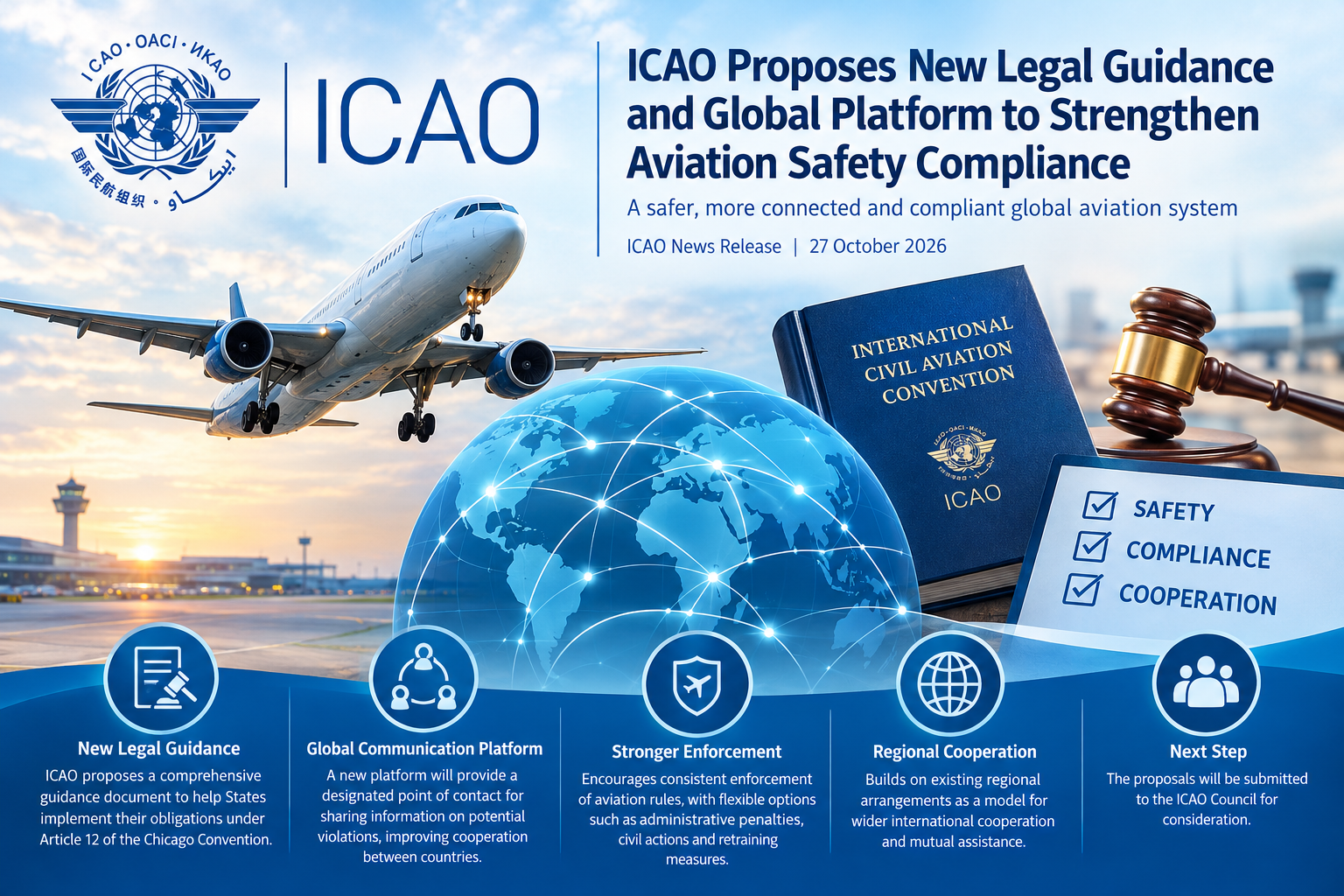
According to an ICAO news release published on 27 October 2026, the initiative follows concerns over inconsistent enforcement of the international “Rules of the Air” and weaknesses in the way countries exchange information about possible violations involving foreign aircraft.
The Rules of the Air, established under the Convention on International Civil Aviation, govern the operation of international flights from takeoff through landing. Under Article 12 of the Chicago Convention, countries are required to enforce these rules for aircraft operating within their territory and for their own aircraft wherever they operate.
States are also expected to keep their national regulations aligned, to the greatest extent possible, with ICAO standards and to take action when violations occur.
However, ICAO said recent reviews have identified significant differences in enforcement practices and coordination among countries. Depending on the jurisdiction, violations may be handled through criminal prosecution, financial penalties, administrative action or retraining.
75% of Surveyed States Lack Information-Sharing Systems
One of the major concerns identified by ICAO is the lack of effective systems for sharing information about violations involving foreign aircraft.
A legal survey found that 75% of responding countries do not have systems to share information on violations involving foreign aircraft.
ICAO said notifications can sometimes be delayed or lost, particularly when incidents occur during flights over the high seas, where questions about jurisdiction can make enforcement more complicated.
Privacy concerns and potential legal risks can also discourage authorities from openly sharing information, creating additional challenges for international safety oversight.
New ICAO Guidance on Article 12
In response, the ICAO Legal Committee has proposed a comprehensive guidance document explaining how States can implement their responsibilities under Article 12.
ICAO described the proposed document as the first comprehensive guidance of its kind.
The guidance is intended to help countries better understand and implement their obligations while improving consistency in the enforcement of international aviation rules.
The committee also emphasized that countries should have flexibility in how they enforce compliance.
According to ICAO, States could use a range of measures, including administrative penalties, civil actions and educational or retraining measures, rather than relying exclusively on criminal prosecution.
The objective is to achieve effective safety outcomes rather than impose an identical enforcement system on every country.
Proposed Communication Platform
ICAO is also proposing a new communication platform that would provide a designated point of contact for notifying countries about potential violations.
The platform is expected to make communication between national authorities more formal and efficient, helping officials identify the appropriate counterparts and exchange information more quickly.
This could be particularly important for international flights that cross multiple jurisdictions, where information about a potential violation may otherwise take longer to reach the appropriate authority.
Regional Cooperation Could Provide a Model
The ICAO Legal Committee also highlighted existing regional cooperation arrangements as potential models for wider international cooperation and mutual assistance.
The organization believes that lessons from existing regional systems could help countries develop more effective mechanisms for exchanging information and coordinating enforcement actions.
However, the proposed measures would not replace national aviation authorities or their legal responsibilities. Instead, they are intended to improve communication and provide clearer guidance for implementing existing international obligations.
Next Step: ICAO Council Review
The recommendations will now be submitted to the ICAO Council for consideration.
The proposals come as aviation authorities face increasingly complex international operations, with aircraft routinely crossing multiple national airspaces and, in some cases, operating over the high seas.
Improving communication between national authorities could help ensure that potential violations are identified, reported and addressed more consistently.
ICAO's initiative therefore represents an effort to strengthen not only the rules governing international aviation, but also the mechanisms used by countries to enforce and cooperate on those rules.
Source: International Civil Aviation Organization (ICAO), news release published 27 October 2026.








Facebook Comments