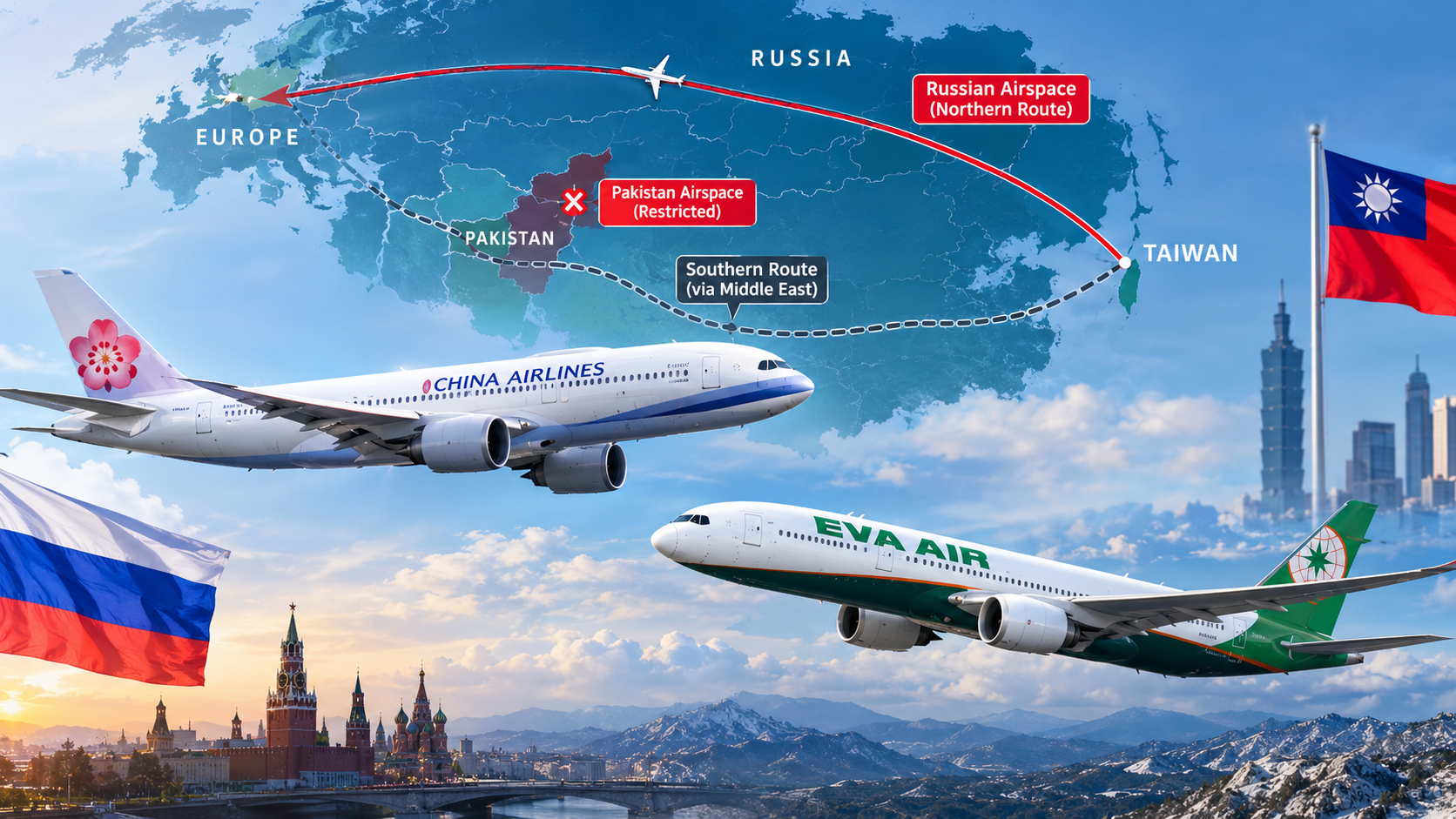
KATHMANDU, Oct. 29, 2026 — Taiwan’s two largest international airlines, China Airlines and EVA Air, have resumed flights through Russian airspace after avoiding the region for more than four years.
The change came after the airlines reportedly faced a temporary restriction on using Pakistani airspace, forcing them to reconsider their normal routes between Taiwan and Europe.
China Airlines and EVA Air began routing some European services over Russia from around October 25. The development represents a significant operational shift for the Taiwanese carriers, which had avoided Russian airspace since Russia’s full-scale invasion of Ukraine in February 2022.
Pakistan Airspace Restrictions Trigger Route Changes
The disruption emerged after Pakistan reportedly restricted access to its airspace for Taiwanese passenger and cargo airlines.
Taiwanese officials said the restriction was linked to Pakistan’s support for Beijing’s “One China” policy. Pakistan’s Defence Minister Khawaja Asif was reported as saying that the country’s aviation policy followed the One China position.
The restriction created a major challenge for Taiwan-Europe services because Taiwanese airlines already face limitations on using mainland Chinese airspace.
With Pakistan temporarily unavailable, airlines had fewer practical routing options. They could either take significantly longer southern routes through the Middle East or use the northern route over Russia.
China Airlines and EVA Air Use Russian Airspace
China Airlines Flight CI75 between Taiwan Taoyuan International Airport and Rome was among the flights observed using Russian airspace.
EVA Air also operated European services through Russia, including flights between Paris and Taipei.
According to flight-tracking data, the northern routing allowed the airlines to avoid Pakistani airspace while maintaining a comparatively efficient path toward Europe.
Taiwan’s transportation authorities said airlines are allowed to select routes according to operational considerations, including safety, flying time and costs.
Taiwan’s Transport Minister Chen Shih-kai said the fact that the airlines were able to operate through Russian airspace indicated that the necessary approvals had been obtained, while the carriers could decide whether to continue using the route.
Pakistan Later Restores Overflight Approvals
The situation changed on October 28, when Pakistan’s Civil Aviation Authority issued approvals allowing China Airlines and EVA Air to operate passenger and cargo flights through Pakistani airspace.
The approvals reportedly cover the period from October 28, 2026, through March 27, 2027. However, the documents did not explicitly explain whether they represented a reversal of an earlier restriction.
Taiwanese officials said the reopening appeared to be temporary, potentially lasting through the winter season.
Neither China Airlines nor EVA Air publicly confirmed all details surrounding the reported Pakistani restriction and subsequent restoration of access.
Geopolitics Increasingly Influences Airline Routes
The episode demonstrates how geopolitical developments can have a direct impact on commercial aviation.
Airlines normally select routes based on factors such as fuel consumption, flying time, airspace charges, safety and available permissions. But diplomatic relationships and international conflicts can suddenly remove established routes from airline networks.
For Taiwan’s carriers, the situation is particularly complicated because they must consider restrictions involving mainland Chinese airspace, while Russia remains a sensitive routing option following the war in Ukraine.
The southern alternative through the Middle East can increase flight time and fuel requirements, while the Russian route provides a more direct northern option for some Europe-bound services.
A Temporary Disruption With Wider Implications
The reported Pakistani restriction appears to have been short-lived, but its impact was enough to push major Taiwanese airlines back into Russian airspace for the first time in more than four years.
The development also highlights the vulnerability of international airline networks to geopolitical decisions. A change in access to just one country’s airspace can force carriers to make rapid operational changes involving fuel planning, flight times, crew schedules and aircraft utilization.
For passengers, the immediate impact may be limited if Pakistani overflight access remains available. However, the episode shows that international flight routes can change quickly when diplomatic and geopolitical conditions shift.
As China Airlines and EVA Air evaluate their European operations, the availability, cost and reliability of different air corridors will remain important factors in determining whether Russian overflights become a temporary response or a more regular operational option.


Facebook Comments