
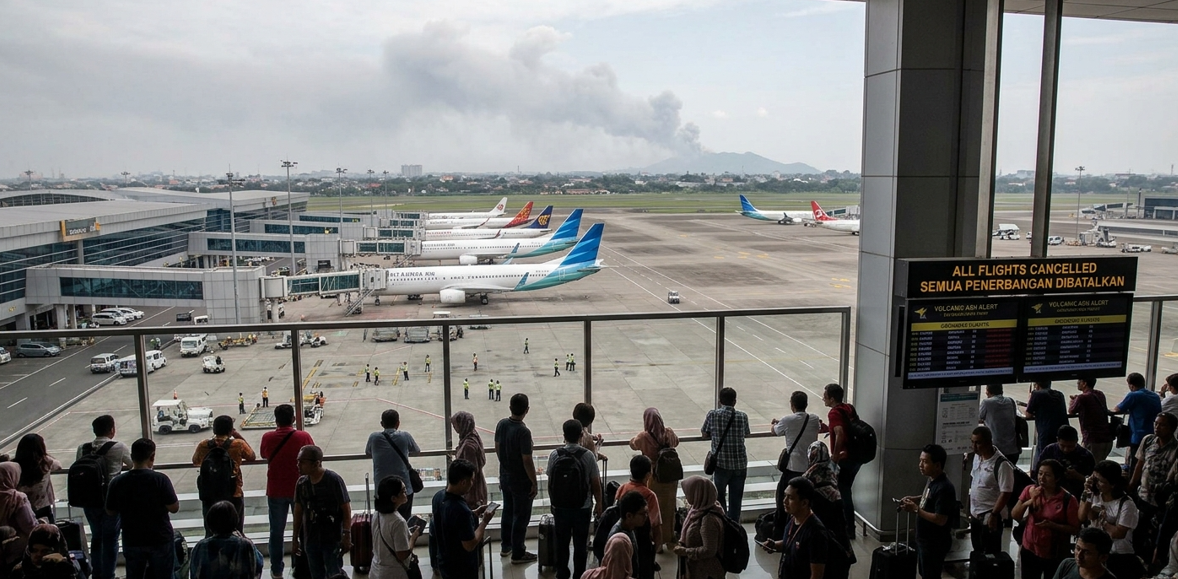
JAKARTA, September 7, 2026 — A powerful eruption of Indonesia’s Mount Anak Krakatau has severely disrupted air travel across the country, forcing the closure of eight regional airports and affecting hundreds of thousands of passengers.
Volcanic ash from the eruption has spread across key regions of Java and Sumatra, creating hazardous conditions for commercial aviation. Jakarta’s primary international gateway, Soekarno-Hatta International Airport, was among the major facilities forced to suspend operations over safety concerns.
According to the latest aviation data, thousands of flights have been cancelled, delayed, or diverted since the eruptive activity intensified over the weekend. Official reports indicate that the ongoing air travel disruption has impacted thousands of flights and over 170,000 travellers across affected transportation hubs.
The eruption has also disrupted key international routes connecting to Jakarta, with global carriers adjusting or cancelling services as atmospheric monitoring teams track the movement of volcanic ash clouds.
Ash clouds reach extreme altitudes
Anak Krakatau, located in the Sunda Strait between Java and Sumatra, launched dense ash columns reaching altitudes of up to 50,000 feet (about 15 kilometres) into upper atmospheric layers.
Shifted by variable high-altitude winds, the airborne particulate matter has drifted across major air corridors, making it difficult for civil aviation authorities to project when full flight schedules can safely resume.
Airlines have strongly advised all passengers to verify their flight statuses before proceeding to airport terminals. Major carriers, including the Lion Air Group, confirmed that operations involving both Soekarno-Hatta and Halim Perdanakusuma airports remain suspended during the mandatory closures.
Passengers face widespread regional disruption
The sudden airspace restrictions have left large volumes of travellers stranded at airports in Jakarta and across surrounding provinces. Secondary disruptions have cascaded to regional airports outside the capital as connecting legs to and from Jakarta were grounded or rerouted.
Transportation authorities extended initial closure orders while continuous runway sweeps and air quality assessments were conducted. Although select regional facilities have evaluated partial reopening as local weather permits, officials caution that renewed eruptive activity could prompt immediate emergency shutdowns.
Local governments have also enacted public safety measures to minimize community exposure to ashfall. Schools across affected sectors in Jakarta and Lampung have transitioned temporarily to remote learning, while health agencies issued advisories urging residents to wear protective masks and limit outdoor exposure.
Volcanologists warn of potential further activity
Indonesia’s Centre for Volcanology and Geological Hazard Mitigation (PVMBG) continue to monitor Anak Krakatau at elevated alert levels, warning that further eruptive episodes remain likely.
The volcano carries a formidable geological history. Anak Krakatau emerged from the caldera formed by the historic 1883 eruption of Krakatoa—one of the most devastating volcanic events on record. In December 2018, an eruption caused a massive flank collapse, triggering a deadly tsunami along the coasts of Java and Sumatra.
For the duration of the current event, aviation authorities affirm that operational decisions will strictly prioritize safety. Flight schedules remain fluid and highly subject to real-time changes in volcanic output, regional wind profiles, and ash dispersal patterns.
Passengers traveling through Jakarta or other impacted Indonesian hubs are advised to maintain direct communication with their respective airlines and check official transport advisories prior to travel.





Facebook Comments