
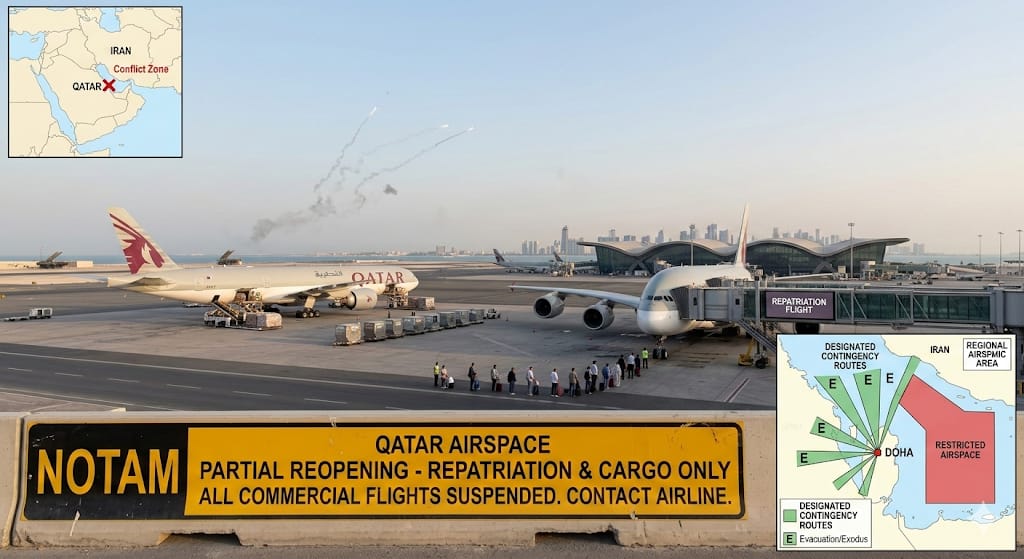
DOHA — In a move that blends logistical necessity with extreme defensive caution, the Qatar Civil Aviation Authority (QCAA) announced a partial reopening of the nation's airspace late Friday evening. The decision follows a grueling seven-day total lockdown of the skies, triggered by the commencement of Operation Epic Fury—the massive U.S. and Israeli military campaign against Iranian strategic assets that began on February 28, 2026.
Navigating the Crossfire
Since the first strikes of the conflict, Qatar has occupied a precarious position. As a central hub for global transit and home to critical U.S. military installations like Al Udeid Air Base, its sovereignty has been tested repeatedly. On Thursday alone, the Ministry of Defence confirmed that Qatar’s air defense systems were forced to engage and destroy a barrage of 14 ballistic missiles and four drones launched from Iranian territory. This followed an even more dramatic encounter on March 2, when Qatari F-15s successfully downed two Iranian Sukhoi Su-24 bombers that had breached its territorial boundaries.
Given these volatile conditions, the QCAA emphasized that the current reopening is not a signal of regional peace, but a managed "lifeline" for those trapped by the conflict. Aircraft are now permitted to use "designated navigational contingency routes," which are corridors of airspace strictly monitored and protected in direct coordination with the Qatari Armed Forces.
Prioritizing the Stranded and Essential
The impact of the airspace closure on the ground has been staggering. Since the grounding began on February 28, more than 2,000 flights have been canceled at Hamad International Airport, leaving thousands of international transit passengers and residents stranded. To begin alleviating this backlog, officials have made it clear that the current phase of operations is reserved exclusively for air cargo and passenger evacuation (repatriation) flights.
Qatar Airways, the national carrier, confirmed it would launch specialized repatriation efforts starting March 7. These flights are specifically targeting five of Europe’s most critical aviation gateways:
-
London (LHR)
-
Paris (CDG)
-
Madrid (MAD)
-
Rome (FCO)
-
Frankfurt (FRA)
The airline has issued a strict protocol for these departures. Boarding priority is being granted through a pre-allocation system focusing on the most vulnerable: families with young children, the elderly, and individuals with urgent medical or compassionate travel needs. Passengers have been warned not to arrive at the airport unless they have received a confirmed, direct notification from the airline, as Hamad International remains closed to standard ticketed traffic.
Economic and Humanitarian Stakes
Beyond the immediate travel chaos, the conflict has sent shockwaves through the global energy market. On March 2, the world’s leading LNG exporter, QatarEnergy, was forced to cease production at its massive Ras Laffan and Mesaieed facilities following targeted Iranian strikes. This disruption has already caused global natural gas prices to spike to record levels, as the "Force Majeure" status on Qatari contracts threatens winter energy security in Europe and Asia.
The partial reopening of the airspace is seen as a vital first step in maintaining the flow of essential goods and the eventual restoration of Qatar’s role as a global connector. However, with the U.S. and Israel indicating that the campaign against Iran could last for weeks, the prospect of a full return to commercial normalcy remains distant.


Facebook Comments