
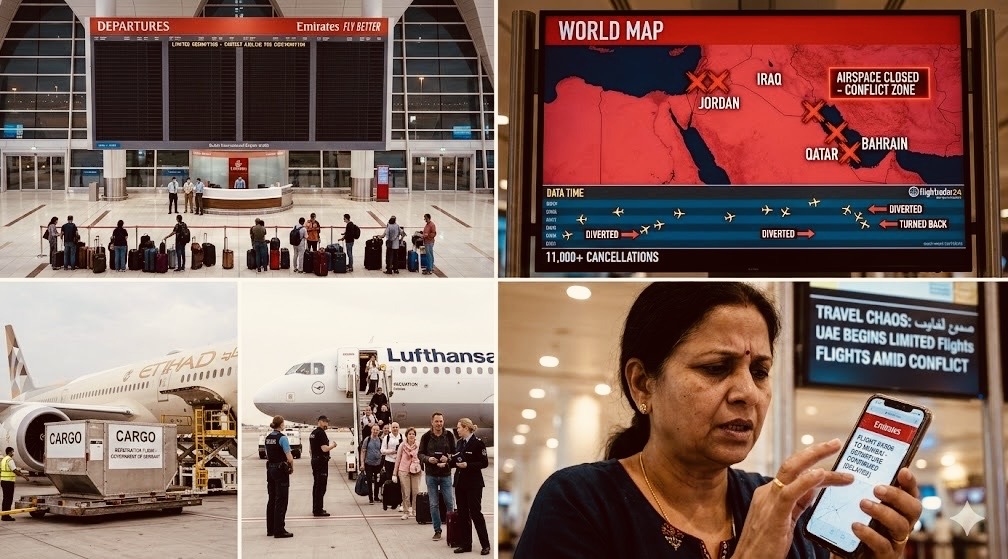
Dubai, March 3, 2026 — The United Arab Emirates has initiated a cautious and limited resumption of air travel following days of intense regional instability linked to the ongoing conflict involving the United States, Israel, and Iran.
Authorities at Dubai International Airport (DXB) — the world’s busiest international passenger hub — and Al Maktoum International Airport (DWC) confirmed that a restricted number of flights were authorized to operate beginning Monday. However, the airport authority has strongly advised passengers not to travel to the airport unless they receive direct confirmation and departure timing from their respective airlines.
Limited Operations at Major UAE Carriers
Emirates resumed a limited flight schedule on Monday evening, prioritizing passengers affected by widespread cancellations over the weekend. The airline confirmed it is gradually restoring services based on evolving airspace conditions.
Meanwhile, Etihad Airways has largely suspended commercial passenger operations until Wednesday. The carrier, however, continues to operate repositioning, cargo, and repatriation flights to maintain essential connectivity.
According to flight tracking data from Flightradar24, at least 16 Etihad aircraft departed Abu Dhabi on Monday, serving key international hubs including London, Amsterdam, and Riyadh. Emirates flights also successfully landed in Mumbai and Chennai early Tuesday morning.
Airspace Closures Intensify Disruptions
The cautious restart comes amid significant operational challenges. On Tuesday morning, multiple flights — including two Etihad aircraft en route to Abu Dhabi and an Emirates flight bound for Dubai — were forced to divert or return mid-air as regional airspace restrictions shifted unexpectedly.
Airspace closures over Iraq, Jordan, Qatar, and Bahrain remain in effect following the escalation of hostilities on February 28.
Aviation analytics firm Cirium reports that more than 11,000 flights have been cancelled since the weekend, impacting over one million passengers worldwide.
Aviation strategist Tony Stanton, Consultant Director at Strategic Air, warned that prolonged instability could reshape global flight networks.
“An Iran-conflict-driven disruption is usually geographically concentrated, but it can still be severe because it affects some of the world’s most critical east–west air corridors. At some point, you may see route maps ‘reset,’ with hubs losing connectivity and traffic shifting toward lower-risk alternatives.”
International Repatriation Underway
With commercial travel options limited, several governments have activated emergency contingency plans:
• Germany has arranged charter evacuation flights to Saudi Arabia and Oman to assist vulnerable citizens.
• The Government of the United Kingdom, under Prime Minister Keir Starmer, has deployed rapid response teams to support approximately 300,000 British nationals across the Gulf region.
• The United States Department of State has urged American citizens to depart the region immediately using any available commercial transportation.
Long-Term Impact on Global Aviation
Industry analysts caution that if the conflict extends beyond several weeks, the global aviation sector may face a structural shift. Rising insurance premiums, evolving safety regulations, and prolonged corridor closures could render traditional Middle Eastern transit routes temporarily unviable.
For now, UAE aviation authorities emphasize that operations remain fluid and subject to rapid changes based on security developments.
Source: Al Jazeera



Facebook Comments