
Middle East | March 1, 2026
Israel has confirmed it carried out pre-emptive military strikes against targets inside Iran, dramatically escalating tensions in the region and prompting widespread airspace closures that have severely disrupted international aviation.
Explosions were reported in several areas, including the Iranian capital, as Israeli officials said the operation was aimed at neutralizing what they described as imminent security threats. Iranian authorities acknowledged the incidents but have yet to release full details on damage or casualties.
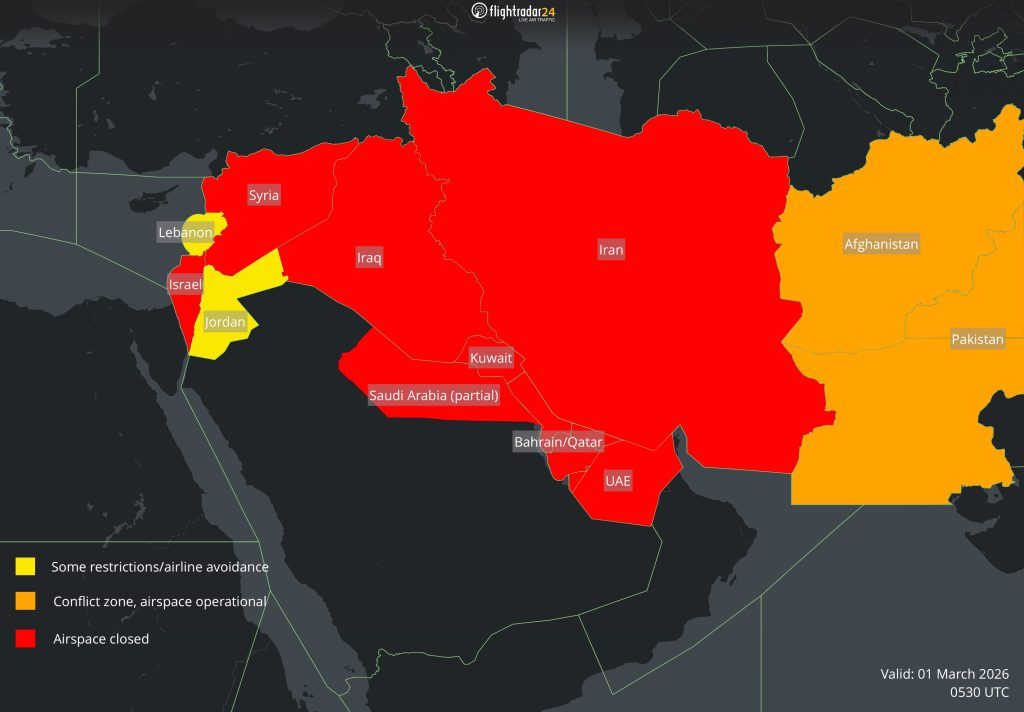
Airspace Shut Down Across the Region
In the immediate aftermath of the strikes, both Israel and Iran closed their airspace to civilian traffic. According to flight tracking data from Flightradar24, commercial aircraft rapidly diverted away from Iranian and Israeli skies, leaving large sections of the region temporarily empty of air traffic.
The closures have had a cascading effect across the Middle East. Several neighboring countries imposed temporary restrictions or precautionary measures, forcing airlines to reroute flights over longer corridors. Major global carriers suspended services to affected destinations, while others diverted mid-air to alternate airports.
Hundreds of flights have been delayed, canceled, or rerouted, impacting tens of thousands of passengers traveling between Europe, Asia, and the Gulf.
Global Aviation Impact
The Middle East serves as a critical transit corridor connecting East and West. With key airspace corridors closed, airlines are now operating longer routes, increasing fuel burn and operational costs. Industry analysts warn that if the closures persist, ticket prices could rise and scheduling disruptions may extend for days or even weeks.
Airlines are advising passengers to check flight status updates regularly as the situation remains fluid.
Rising Regional Tensions
The strikes mark one of the most significant direct escalations between Israel and Iran in recent years. International leaders have called for restraint amid fears of broader regional instability.
Security analysts say the developments could reshape short-term aviation risk assessments across the Middle East, with airlines likely to exercise extreme caution even if airspace gradually reopens.
For now, the priority for aviation authorities remains passenger safety, operational coordination, and monitoring further geopolitical developments.







Facebook Comments