

You arrive at the airport excited for your trip, only to be stopped at the check-in counter. The airline agent places your suitcase on the scale, looks up, and tells you it's overweight. Suddenly, your vacation starts with an unexpected baggage fee.
Or perhaps you're flying on a budget airline, expecting to place your carry-on suitcase in the overhead bin, only to discover that your ticket only includes a small backpack that fits under the seat.
If you've ever been confused by airline baggage policies, you're not alone. Every airline seems to have its own rules, making baggage allowances feel like a complicated puzzle. The good news is that most airlines follow one of two global baggage systems. Once you understand these, packing becomes much simpler—and you can avoid costly surprises at the airport.
Here's everything you need to know about domestic and international baggage rules, including checked baggage, carry-on allowances, and the key differences between Economy, Business, and budget airlines.
The Two Global Baggage Systems
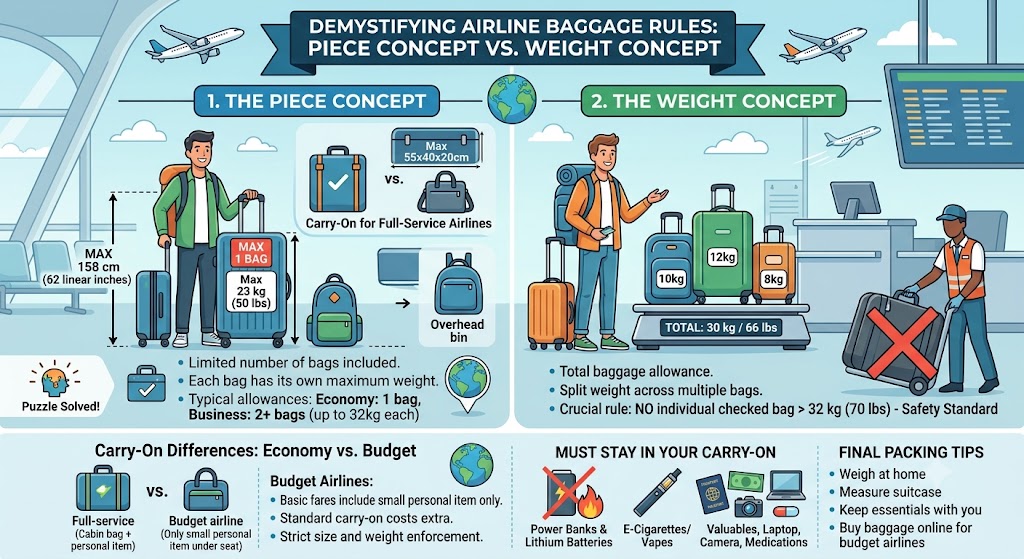
Although airlines publish different baggage policies, nearly all checked baggage allowances are based on one of two systems.
- The Piece Concept
Under the Piece Concept, your ticket includes a specific number of checked bags. Each bag has its own maximum weight limit.
Typical allowances include:
- Economy Class: 1 checked bag up to 23 kg (50 lbs)
- Business or First Class: 2 or more checked bags, each up to 32 kg (70 lbs)
Each checked bag must also stay within the maximum size limit of 158 cm (62 linear inches). This measurement is calculated by adding the bag's length + width + height, including wheels and handles.
If a bag exceeds either the weight or size limit, airlines usually charge overweight or oversized baggage fees.
- The Weight Concept
The Weight Concept gives you a total baggage allowance instead of limiting the number of bags.
For example, if your allowance is 30 kg, you may split that weight across multiple suitcases, provided the combined weight does not exceed your limit.
However, there is one important exception:
No individual checked bag may weigh more than 32 kg (70 lbs).
This is an international safety standard designed to protect airport baggage handlers from lifting excessively heavy luggage.
Carry-On Baggage Rules: Economy vs. Business vs. Budget Airlines
While checked baggage rules differ, carry-on policies can vary even more.
Most airlines allow cabin bags with dimensions close to:
55 × 40 × 20 cm (22 × 14 × 9 inches)
However, the way airlines enforce weight limits depends largely on where you're flying and the airline's business model.
Full-Service Airlines
Many major airlines include one overhead carry-on bag plus one personal item, such as:
- Laptop bag
- Handbag
- Small backpack
In the United States and Canada, airlines rarely weigh cabin bags. As long as your bag fits in the overhead bin and you can lift it yourself, you'll usually be allowed to board with it.
In contrast, many airlines across Europe, Asia, Australia, and the Middle East routinely weigh carry-on baggage. Cabin baggage allowances typically range between 7 to 10 kg (15–22 lbs), including personal items.
Budget and Ultra-Low-Cost Airlines
Budget airlines operate very differently.
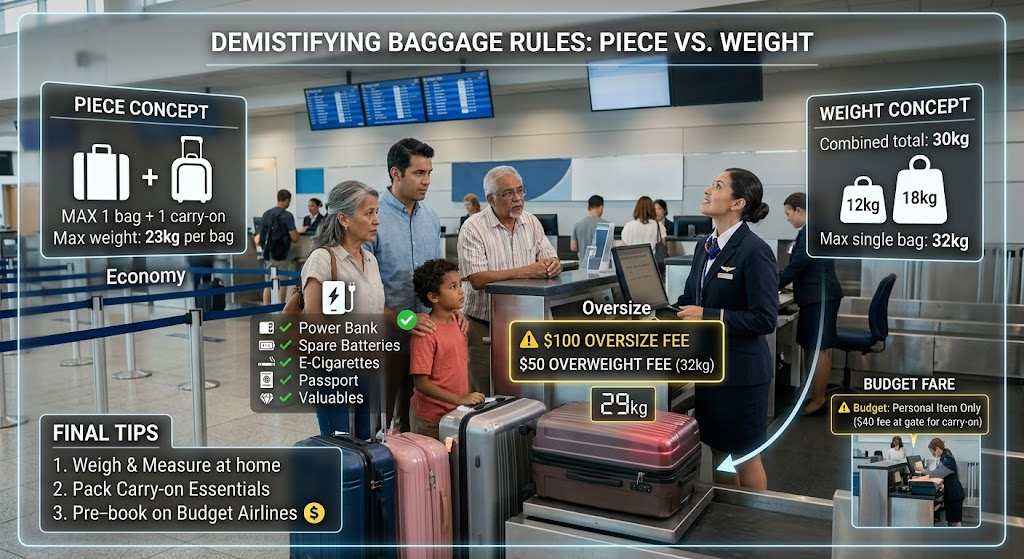
Their lowest fares often include only one small personal item that fits under the seat in front of you.
If you want to bring a standard rolling carry-on for the overhead bin, you'll usually need to purchase an additional baggage option. Paying at the airport is often significantly more expensive than adding it during booking.
Before flying with a low-cost carrier, always check the airline's baggage policy carefully to avoid unexpected fees.
What Must Stay in Your Carry-On?
Certain items are required to travel in your cabin baggage for safety reasons.
Power Banks & Spare Lithium Batteries
Portable chargers and spare lithium batteries must never be packed in checked baggage because damaged batteries can pose a fire risk inside the cargo hold.
E-Cigarettes & Vapes
Electronic cigarettes and vaping devices must also remain in your carry-on luggage. They are prohibited in checked baggage on most airlines.
Valuables & Essential Items
Always keep important belongings with you, including:
- Passport and travel documents
- Cash and credit cards
- Jewellery
- Laptops, tablets, and cameras
- Prescription medications
- Keys and other valuables
If checked luggage is delayed or lost, you'll still have access to your essential items.
Economy vs. Business Class Baggage Comparison
|
Feature |
Economy Class |
Business / First Class |
|
Checked Bag Weight |
Up to 23 kg (50 lbs) |
Up to 32 kg (70 lbs) per bag |
|
Maximum Bag Size |
158 cm (62 linear inches) |
158 cm (62 linear inches) |
|
Checked Bags Included |
Usually 1 bag (basic fares may charge extra) |
Typically, 2–3 checked bags |
|
Carry-On Allowance |
1 cabin bag + 1 personal item |
Usually, 2 full-size cabin bags + personal item |
|
Baggage Handling |
Standard baggage delivery |
Priority-tagged bags are delivered first |
Budget Airlines at a Glance
If you're flying with an ultra-low-cost carrier, remember these key differences:
- Basic fares often include only one small personal item.
- Standard carry-on roller bags usually require an additional fee.
- Checked baggage is almost always purchased separately.
- Airport baggage fees are typically much higher than booking baggage in advance online.
- Airlines strictly enforce both baggage size and weight limits.
Final Packing Tips
Before issue the ticket and heading to the airport, take a few minutes to review your airline's baggage policy. A quick check can save you time, money, and unnecessary stress.
For a smoother journey:
- Weight your luggage at home before leaving.
- Measure your suitcase, including wheels and handles.
- Keep lithium batteries, electronics, medications, and travel documents in your carry-on.
- If flying on a budget airline, purchase baggage online before your travel day.
- When in doubt, pack lighter. Avoiding overweight baggage fees is often worth leaving a few items behind.
Understanding the difference between the Piece Concept and the Weight Concept, along with knowing your airline's carry-on rules, will help you travel confidently, avoid unexpected charges, and start your trip without last-minute surprises at the check-in counter






Facebook Comments